Roof Edge Protection- Imperative to job site safety
Working at heights is an everyday part of roofing and construction, but it comes with significant risks. Unprotected roof edges, elevated work surfaces, and changing jobsite conditions can expose workers to serious fall hazards.
For roofing contractors, construction companies, and facility managers, protecting workers around roof perimeters should be a fundamental part of every jobsite safety plan.
One of the most effective forms of collective fall protection is a roof safety guardrail system. Unlike personal fall protection equipment that protects an individual worker, properly designed guardrail systems establish a physical barrier around exposed areas, helping protect everyone working within the designated space.
Whether you are managing a commercial roofing project, performing rooftop maintenance, or overseeing a construction site, understanding roof guardrail requirements, installation considerations, and equipment selection is essential.
In this guide, we will explore how roof safety guardrails work, OSHA requirements, different types of guardrail systems, inspection procedures, and how to choose the right roof edge protection for your project.
1. Why Are Roof Safety Guardrails Important?
Falls are a major hazard in the construction industry. Workers frequently perform tasks near roof edges, openings, skylights, and elevated platforms where a loss of balance can result in a serious injury.
Roof safety guardrails provide a physical barrier designed to prevent workers from accidentally accessing exposed edges.
Unlike systems that depend on an individual worker maintaining a connection to an anchorage point, guardrails provide collective protection to workers within the protected area.
Key Benefits of Roof Guardrail Systems
Collective fall protection
Guardrails can protect multiple workers simultaneously without requiring each individual to connect to a personal fall arrest system.
Reduced exposure to roof edges
A properly installed guardrail creates a visible and physical boundary between workers and exposed roof perimeters.
Improved jobsite awareness
Visible guardrail systems help define protected work areas and make hazardous roof edges easier to recognize.
Support for OSHA compliance
Guardrail systems are one of the recognized methods of fall protection under OSHA construction regulations when properly designed, installed, and used.
Greater flexibility for rooftop operations
Depending on the system design, guardrails can provide protection for roofing crews, maintenance personnel, HVAC technicians, and other professionals who work on elevated surfaces.
Roof safety guardrails are not simply barriers. They are engineered safety systems that must meet specific performance requirements to provide the intended level of protection.
2. Understanding OSHA Roof Guardrail Requirements
The Occupational Safety and Health Administration (OSHA) establishes specific requirements for fall protection in the construction industry.
Two particularly important regulations for roof safety guardrails are:
OSHA 29 CFR 1926.501: Duty to Have Fall Protection.
OSHA 29 CFR 1926.502: Fall Protection Systems Criteria and Practices.
Understanding the difference between these standards is important when selecting and installing a roof guardrail system.
When Is Roof Fall Protection Required?
Under OSHA 29 CFR 1926.501, employees working on unprotected sides or edges that are 6 feet or more above a lower level generally must be protected from falls.
For roofing operations, the specific requirements depend on the roof type and work being performed.
Low-slope roofs
Under OSHA 1926.501(b)(10), workers performing roofing activities on low-slope roofs with unprotected sides or edges 6 feet or more above lower levels must be protected using permitted systems.
These include:
Guardrail systems.
Safety net systems.
Personal fall arrest systems.
Certain combinations involving warning lines and other permitted protection methods.
For low-slope roofs that are 50 feet or less in width, OSHA also permits a safety monitoring system alone under the conditions specified in the regulation.
Steep-slope roofs
Under OSHA 1926.501(b)(11), workers on steep roofs with unprotected sides or edges 6 feet or more above lower levels must be protected using:
Guardrail systems with toeboards.
Safety net systems.
Personal fall arrest systems.
The correct fall protection method must be selected based on the specific work activity and applicable OSHA requirements.
OSHA Guardrail Height Requirements
OSHA 1926.502(b) establishes specific design and performance requirements for guardrail systems.
Some of the most important requirements include:
Top rail height: The top edge of the top rail must generally be 42 inches, plus or minus 3 inches, above the walking or working surface.
Midrail requirements: When there is no wall or parapet at least 21 inches high, midrails, screens, mesh, or equivalent intermediate structural members must be installed between the top rail and working surface.
Top rail strength: Guardrail systems must withstand a force of at least 200 pounds applied within 2 inches of the top edge in an outward or downward direction.
Midrail strength: Midrails and other intermediate structural members must withstand at least 150 pounds of force in an outward or downward direction.
Surface requirements: Guardrails must not have surfaces that create puncture, laceration, or clothing-snagging hazards.
These specifications are important when evaluating whether a guardrail system is suitable for a construction application.
For the complete requirements, consult the official OSHA standards:
OSHA 1926.501: https://www.osha.gov/laws-regs/regulations/standardnumber/1926/1926.501
OSHA 1926.502: https://www.osha.gov/laws-regs/regulations/standardnumber/1926/1926.502
3. How Do Roof Safety Guardrails Work?
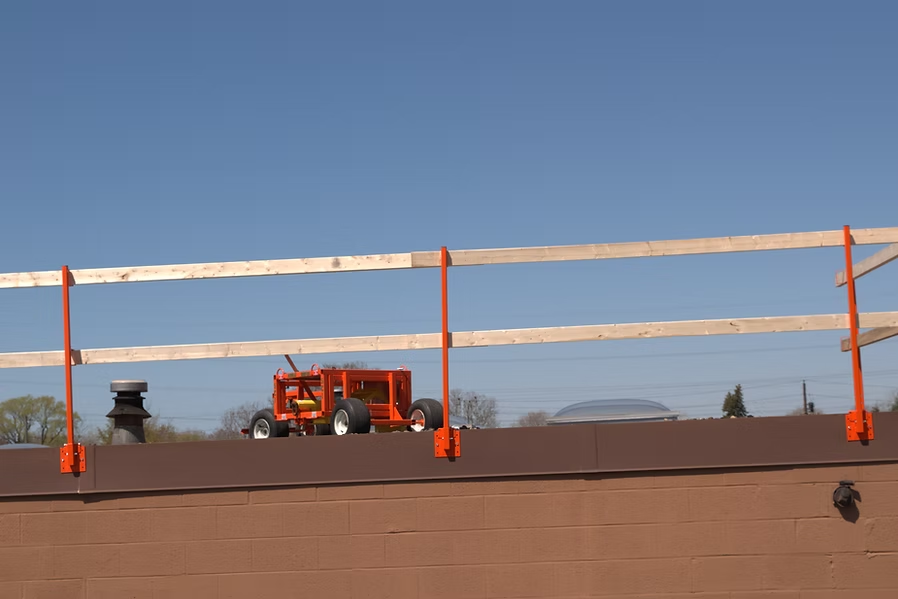
Roof safety guardrails function by establishing a physical barrier along exposed edges and other designated areas.
When properly designed and installed, they help prevent workers from unintentionally reaching or falling over a roof perimeter.
Most conventional guardrail systems incorporate several important components.
Top Rail
The top rail is the primary horizontal barrier positioned above the walking or working surface.
It must meet applicable height and strength requirements under OSHA regulations.
Midrail
The midrail provides an additional barrier between the top rail and the roof surface.
It helps prevent workers from passing underneath the top rail.
Guardrail Posts
Posts provide the structural support necessary to maintain the position and integrity of the guardrail system.
Their spacing, attachment method, and structural capacity must be appropriate for the system's design.
Base Plates and Mounting Components
Depending on the guardrail design, mounting components secure the posts and transfer forces into the supporting structure.
These components may include clamps, counterweights, anchors, or other manufacturer-specified attachment methods.
The roof structure and attachment method must be suitable for the intended installation.
Toeboards
Toeboards help prevent tools, materials, and other objects from falling from elevated work areas.
Where required, they must meet applicable OSHA requirements for height, strength, and openings.
Not every guardrail system uses the same components or installation method. Contractors should always follow the manufacturer's instructions and verify that the complete system meets the applicable requirements.
4. Different Types of Roof Guardrail Systems
Roof guardrails come in several configurations designed for different construction and maintenance applications.
Selecting the appropriate system requires consideration of roof construction, project duration, access requirements, and the intended attachment method.
Temporary Roof Guardrail Systems
Temporary guardrails are designed for projects where fall protection is needed for a limited period.
Common applications include:
Commercial roofing installations.
Roof repairs and replacements.
Construction and renovation projects.
Temporary rooftop maintenance operations.
These systems may be designed for repeated installation and removal, making portability and ease of assembly important considerations.
Permanent Roof Guardrail Systems
Permanent guardrails are typically installed on buildings where ongoing rooftop access is necessary.
Common applications include:
Commercial building maintenance.
HVAC servicing.
Rooftop equipment inspections.
Industrial facilities.
Mechanical and utility access areas.
Permanent systems can provide a continuous form of edge protection for locations where workers regularly access the roof.
Non-Penetrating Guardrail Systems
Some temporary roof guardrail systems use counterweights or other non-penetrating designs to provide stability without fastening directly through the roofing membrane.
These systems can be useful where protecting the integrity of the roof surface is important.
However, non-penetrating does not automatically mean suitable for every roof. Roof construction, slope, surface conditions, system configuration, and manufacturer specifications must all be evaluated.
Clamp-On and Mechanically Attached Guardrails
Other systems use clamps, brackets, or mechanical attachments to connect to an appropriate structural component.
These systems require careful evaluation of the attachment point, supporting structure, and manufacturer installation instructions.
The most appropriate guardrail configuration depends on the specific roof and application.
5. How to Choose the Right Roof Safety Guardrail System
Selecting a roof guardrail system should involve more than comparing prices or choosing the easiest product to install.
Contractors should evaluate several factors before purchasing or deploying equipment.
Roof Type and Construction
Consider whether the project involves:
Flat or low-slope roofing.
Steep-slope roofing.
Metal roofing.
Membrane roofing.
Concrete roof decks.
Other specialized roof assemblies.
Different roof structures require different mounting and stabilization considerations.
Attachment Method
Determine how the guardrail system will be secured.
Some systems use counterweights, while others rely on mechanical attachments or specialized mounting hardware.
The attachment method must be compatible with the roof structure and approved system configuration.
Portability and Installation
For contractors working across multiple projects, portability can be an important consideration.
Look for systems that offer practical transportation, straightforward assembly, and clearly documented installation procedures without compromising safety requirements.
Material and Durability
Roof guardrails are exposed to outdoor conditions, including rain, snow, sunlight, and temperature fluctuations.
Material selection should account for corrosion resistance, structural integrity, and the intended service environment.
OSHA Compliance
Always verify that the complete guardrail system meets the applicable OSHA performance requirements.
Do not assume that a system is compliant simply because it is marketed as a safety guardrail.
Review manufacturer documentation, installation instructions, testing information, and any applicable certifications.
6. Roof Guardrail Installation and Inspection Best Practices
Even a properly designed guardrail system can become ineffective if it is incorrectly installed, damaged, or improperly maintained.
Installation and inspection procedures should be incorporated into every roofing safety program.
Before Installation
Before installing a roof guardrail system:
Evaluate the roof structure and working conditions.
Identify exposed edges and other fall hazards.
Review the manufacturer's installation instructions.
Confirm that the attachment method is appropriate.
Verify that all required components are available.
Ensure employees understand the installation procedure.
During Installation
Workers should follow the manufacturer's specified installation sequence and verify that components are properly assembled.
Pay particular attention to:
Post positioning.
Attachment and mounting components.
Top rail and midrail placement.
Required system spacing.
Structural support.
Manufacturer-specified configurations.
Never modify guardrail components or substitute hardware unless the manufacturer or qualified design professional has approved the change.
Routine Guardrail Inspections
Guardrail systems should be inspected before use and whenever conditions could affect their integrity.
Look for:
Bent or damaged posts.
Loose or missing hardware.
Corrosion or material deterioration.
Damaged rails.
Improper attachment or mounting.
Missing components.
Unauthorized modifications.
Changes in roof conditions that could affect system stability.
Any damaged or questionable component should be addressed before the system is relied upon for fall protection.
Inspection procedures should follow manufacturer recommendations and applicable workplace safety requirements.
7. Roof Guardrails vs. Personal Fall Arrest Systems
Guardrails and personal fall arrest systems are both important forms of fall protection, but they serve different purposes.
Understanding the difference helps contractors select appropriate protective measures.
Roof Guardrail Systems
Guardrails provide passive or collective protection by establishing a physical barrier around exposed areas.
Advantages include:
Protecting multiple workers simultaneously.
Reducing dependence on individual worker connections.
Providing a visible physical boundary.
Allowing workers to move within protected areas without continuously reconnecting to an anchorage system.
Personal Fall Arrest Systems
Personal fall arrest systems are designed to stop a worker after a fall has occurred.
They generally include:
Full-body harnesses.
Connecting devices.
Energy-absorbing lanyards or self-retracting lifelines.
Appropriate anchorage points.
These systems require proper fit, inspection, compatibility, fall clearance, and rescue planning.
Which System Is Better?
Neither system is universally better.
Guardrails can be an excellent option when collective protection is practical and appropriate for the jobsite.
Personal fall arrest systems may be necessary when guardrails are not feasible or when workers need to perform tasks outside a protected perimeter.
In some situations, a combination of protective measures may be appropriate.
The goal is to select a system that provides effective protection for the actual work being performed.
8. Common Roof Guardrail Safety Mistakes
Even experienced contractors can make mistakes when selecting, installing, and maintaining guardrail systems.
Some of the most common problems include:
1. Incorrect guardrail height
Top rails must meet applicable OSHA height requirements. Improper positioning can compromise the intended protection.
2. Missing midrails or intermediate protection
Guardrails must include appropriate intermediate structural members when required by OSHA 1926.502(b).
3. Improper attachment
A guardrail is only as effective as its supporting structure and attachment method.
4. Using incompatible components
Mixing components from different systems without manufacturer approval can compromise system performance.
5. Failing to inspect equipment
Damaged posts, loose hardware, and deteriorated materials can affect system integrity.
6. Assuming every roof requires the same system
Roof type, slope, structural characteristics, and work activities all influence equipment selection.
7. Ignoring falling object hazards
Guardrails do not automatically eliminate the risk of tools or materials falling from elevated surfaces. Additional protective measures may be necessary.
Addressing these mistakes through proper training, equipment selection, and inspection procedures can help create a safer working environment.
9. Why Roof Edge Protection Matters Beyond Roofing
Roof safety guardrails are not limited to traditional roofing contractors.
Many industries require employees to access elevated roof surfaces for installation, inspection, repair, and maintenance.
Some common applications include:
Commercial HVAC: Technicians frequently access rooftops to service heating, ventilation, and air conditioning equipment.
Building maintenance: Facility personnel may need to inspect rooftop equipment, drainage systems, and building components.
Construction: Workers performing installation, renovation, and repair activities may be exposed to unprotected roof edges.
Industrial facilities: Maintenance teams often access elevated platforms and rooftops as part of routine operations.
Solar installation: Workers installing and maintaining rooftop solar systems may encounter significant edge exposure.
For each application, the appropriate fall protection method should be determined based on the hazards and applicable safety requirements.
10. Improving Jobsite Safety With the Right Equipment
A comprehensive fall protection program requires more than one piece of equipment.
Roof guardrails, personal fall arrest systems, roof brackets, ladder stabilization products, and other protective equipment all serve different purposes.
The best safety programs evaluate the entire work environment and select equipment based on the hazards employees actually encounter.
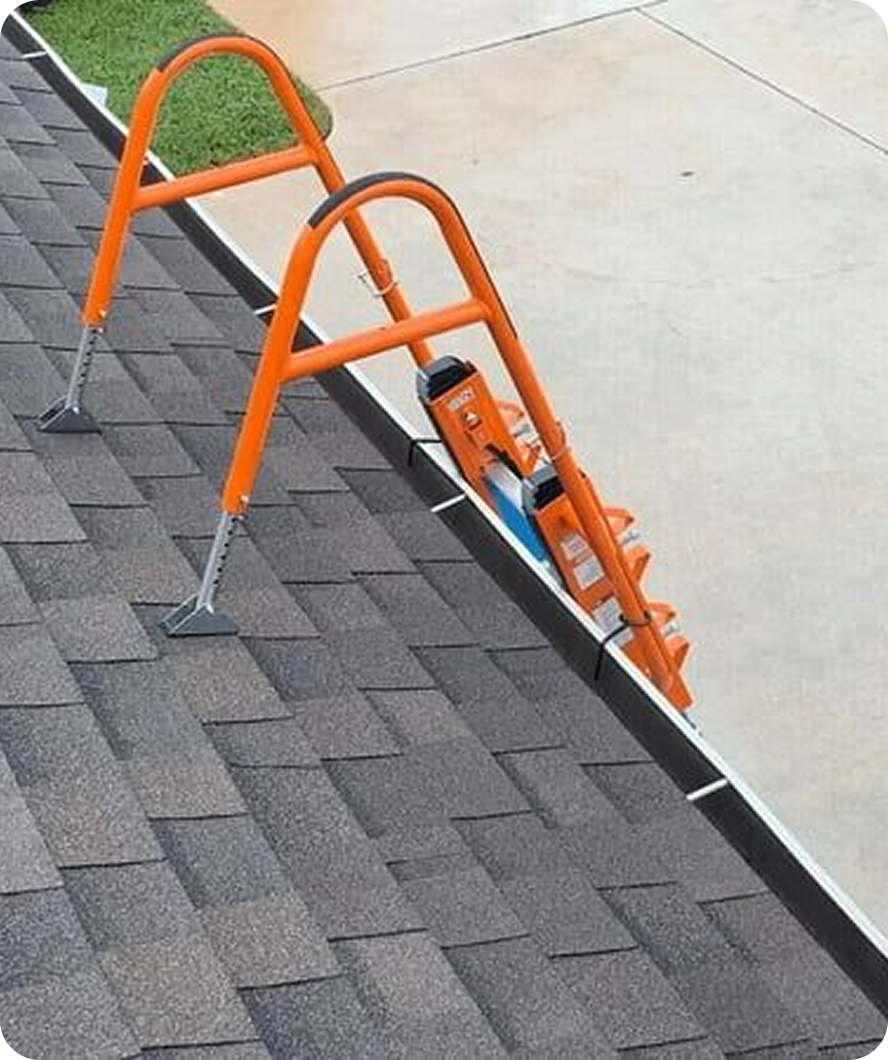
At On Top Safety, we develop innovative safety equipment designed to address real-world challenges faced by roofing professionals and workers operating at heights.
Our Fast Track Guardrail System is part of our fall protection product line, offering contractors another solution to consider when evaluating roof edge protection.
Whether you are looking for roof guardrail systems, ladder stabilization equipment, or specialized fall protection solutions, selecting the right equipment is an important step toward improving jobsite safety.
Explore the On Top Safety product line to learn more about our solutions for roofing contractors, construction professionals, and other industries.
Frequently Asked Questions About Roof Safety Guardrails
1. What is a roof safety guardrail?
A roof safety guardrail is a physical barrier installed along exposed roof edges or other designated areas to help prevent workers from falling to lower levels.
2. What height should a roof guardrail be?
Under OSHA 1926.502(b)(1), the top edge of a construction guardrail must generally be 42 inches, plus or minus 3 inches, above the walking or working surface.
3. At what height does OSHA require roof fall protection?
For many construction activities, fall protection is required when employees are exposed to falls of 6 feet or more above a lower level. Specific requirements depend on the work being performed and the applicable OSHA provision.
4. How much force must an OSHA-compliant guardrail withstand?
Under OSHA 1926.502(b)(3), the top rail must withstand at least 200 pounds of force applied within 2 inches of the top edge in an outward or downward direction.
Intermediate structural members must generally withstand at least 150 pounds of force.
5. Are roof guardrails better than harnesses?
Guardrails provide collective protection for workers within a designated area, while personal fall arrest systems protect individual workers by stopping a fall.
The appropriate system depends on the jobsite and the work being performed.
6. Are non-penetrating roof guardrails available?
Yes. Some temporary roof guardrail systems use counterweights or other non-penetrating designs rather than fastening directly through the roof membrane.
However, the system must be suitable for the roof structure, conditions, and intended application.
7. Do roof guardrails require midrails?
Under OSHA 1926.502(b)(2), midrails, screens, mesh, or equivalent intermediate structural members must be installed when there is no wall or parapet at least 21 inches high. Specific design requirements apply.
8. How often should roof guardrails be inspected?
Guardrails should be inspected before use and whenever conditions could affect their integrity. Contractors should follow manufacturer inspection instructions and applicable safety requirements.
9. Can roof guardrails be used on sloped roofs?
Certain guardrail systems can be designed for specific sloped roof applications. However, the system must be appropriate for the roof slope, attachment conditions, and applicable fall protection requirements.
10. What industries use roof safety guardrails?
Roof guardrails are used in commercial roofing, construction, industrial maintenance, HVAC servicing, facility management, and other applications involving elevated work surfaces.
Final Thoughts: Making Roof Edge Protection a Priority
Roof safety guardrails play an important role in protecting workers from fall hazards.
By creating a physical barrier around exposed edges, properly designed guardrail systems can provide collective protection and help contractors establish safer working environments.
However, effective roof edge protection requires more than purchasing equipment. Contractors must understand OSHA requirements, select appropriate systems, follow manufacturer installation instructions, and establish consistent inspection procedures.
At On Top Safety, we believe innovation plays an important role in advancing workplace safety. Our mission is to develop practical, innovative solutions that address the challenges faced by professionals working at heights.